
Night fishing using a spear and a torch | Lystring
An ancient fishing method was to catch fish after dark, using a multi-pronged spear and a torch. The Norwegians call it lystring — in English, leistering.

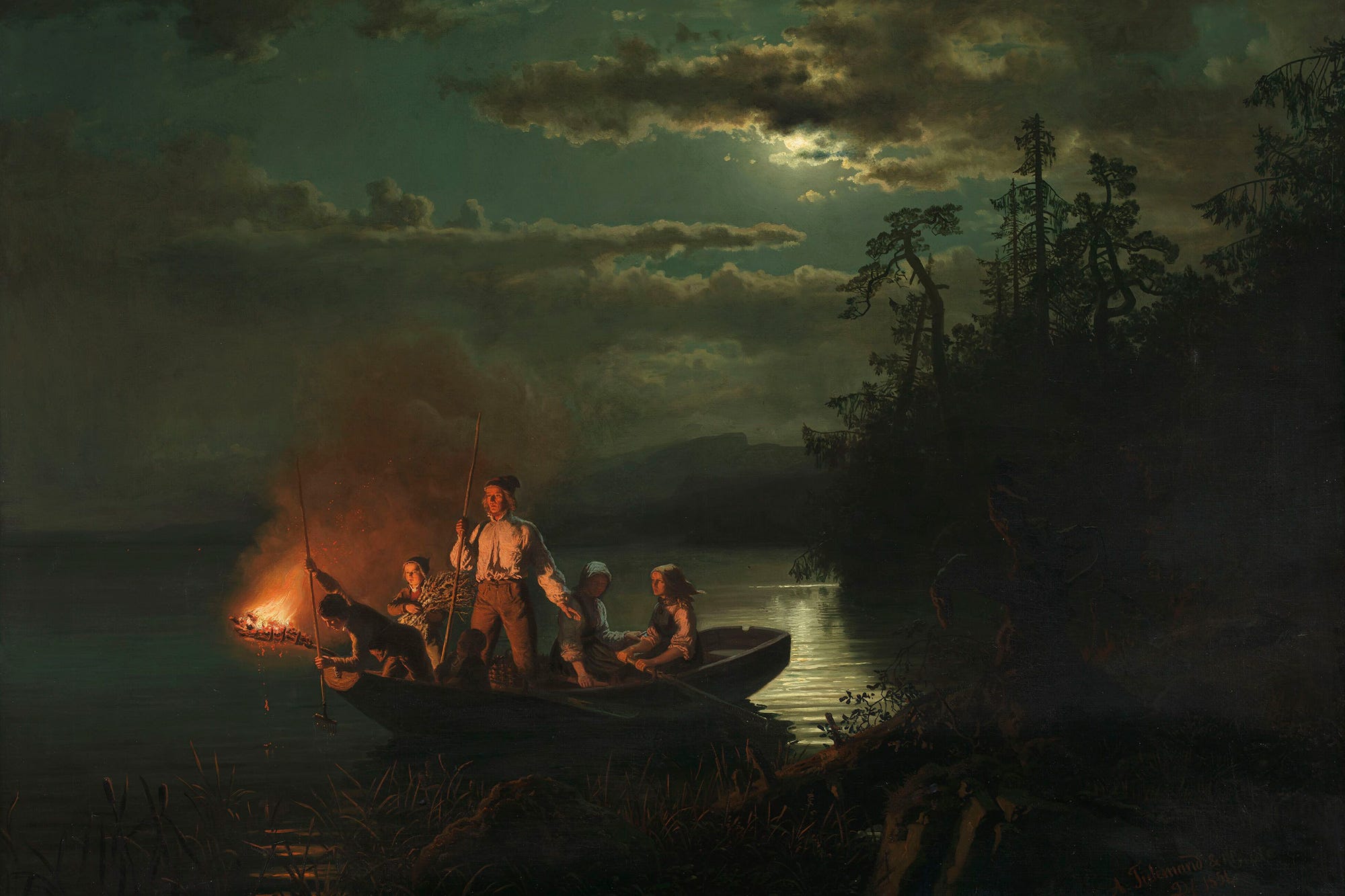
A leister is an ancient fishing tool
Lystring is the gerund form of the Norwegian verb å lystre. The word comes from the Old Norse verb ljósta, meaning to hit, thrust, or stab.
The verb comes from the noun lyster, meaning a fishing spear with a long wooden shaft and barbed prongs attached to its end.
In English, both the verb and the noun are spelt leister.
The leister is believed to go back thousands of years, to the Stone Age and its hunter-fisher-gatherers.
Luring prey with light
The fisher lured the prey towards them with the light from the torch. They usually used a boat, but could also stand in the water, on a rock, or on the riverbank or shore.
The leistering often took place when darkness returned in the autumn. The fisher, or someone next to them, held a fire torch above the water’s surface to attract the fish.
The fisher could also attach the torch to the side of the boat — or to a pole sticking out from the boat over the water.
Speed was of the essence
When a fish appeared, the person holding the leister had to thrust it quickly towards the fish to have any hope of catching it.
To avoid losing the leister into the water, they often attached a piece of rope to the end of its long wooden shaft and tied the rope around their wrist.
When leistering, the fisher could catch trout (ørret), pike (gjedde), burbot (lake), eel (ål), and many other species.
Lystring differs slightly from the fishing method lysing, where the fisher wades in the water after dark, using a torch to attract crabs, crayfish, and other prey, and then catches them by hand.
Please note: As a rule, leistering is not a legal fishing method in Norway today. Anyone fishing must first check the current national and local regulations for both freshwater and saltwater fishing.
Haugen, Einar. Norwegian English dictionary. The University of Wisconsin Press 1967, 1974. | Det norske akademis ordbok. naob.no. | Store norske leksikon snl.no.