
Stabbur | The food storehouse on the old Norwegian farm
Like all buildings on the traditional Norwegian farm, the stabbur had a clear purpose: to store food — and sometimes also fine clothing and other fragile possessions.

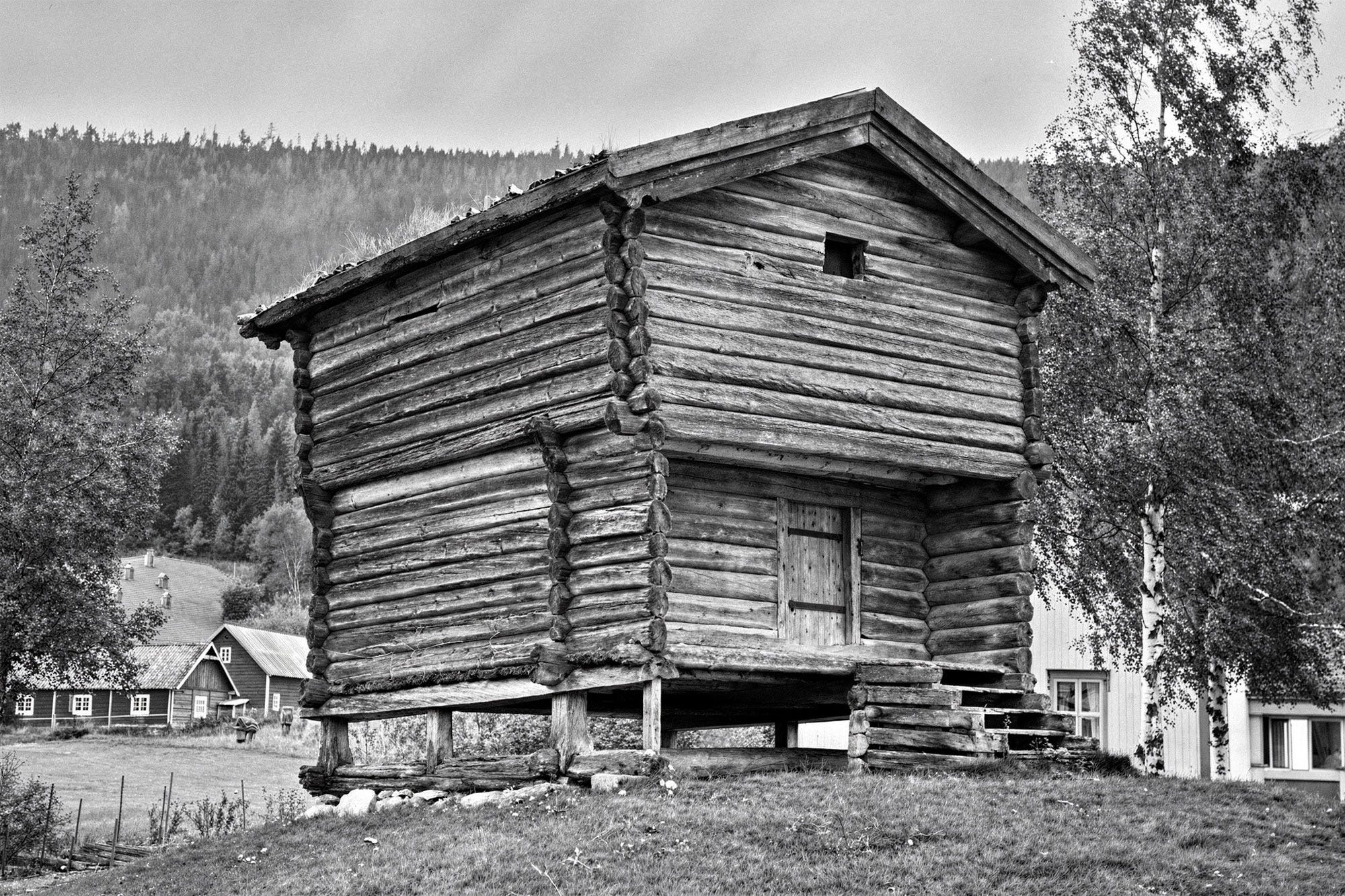
Keeping the rodents out
The Norwegians placed the stabbur on wooden stilts or boulders — structures specifically designed to keep rodents and other creatures out.
Throughout summer and autumn, the farmers worked hard to stock the stabbur with enough food to last through a long and frosty winter.
The stabbur contained foods such as threshed grain, flour, flatbread, butter, frost-resistant cheese, and dried, smoked, or salted meat and fish.
The stabbur did not have a fireplace, so the food and items stored there had to withstand low temperatures. Frost-sensitive foods — such as some vegetables, milk, eggs, and other perishable products — needed to be kept in a frost-free location. These were typically stored in a cool indoor pantry or in an earth cellar, either underneath the main house or outdoors.
A building of all sizes
Typically — but not always — the stabbur was a wooden structure. The earliest versions were built using a stave‑type construction, but from the Viking Era onwards the lafting log‑building technique became more dominant, at least in some regions of the country.
The stabbur came in all shapes and sizes, depending on the number of people living on the farm and the volume of the farm’s produce.
Some farms had more than one stabbur, and sometimes the building stood apart from the main courtyard as a safety measure — in case of a fire.
The stabbur had small windows or hatches, but often no openings other than the main door. This helped keep the interior as cool as possible during the summer — and not too cold during the winter.
The only door with a lock
On the old Norwegian farm, the stabbur door was often the only one with a lock. The mistress of the farm was the keeper of the key — a sign of her undisputed status.
In Norwegian literature, the passing of the stabbur key — from one generation to the next — often stirred strong emotions and a sense of change and drama. Stepping down as its keeper could be painful after a lifetime in charge.
As old as the Vikings
The stabbur has deep roots in Norwegian culture. The Viking Gulating Law mentioned the building as early as in the 900s.
One clear requirement in the Gulating Law was that a tenant farmer had to leave the stabbur in good condition upon ending his tenancy.
The Viking lawmakers were also clear on one particular point: if a man was caught stealing inside your stabbur, you had the right to strike him dead on the spot.
The Sami peoples also had elevated buildings and constructions similar to the stabbur, protecting both food and equipment.
Symbols of the past
The old stabbur still stands on many Norwegian farms — now often empty reminders of the past.
Some of the existing stabburs are very old, and many are beautifully crafted and decorated.
The use of the stabbur changed dramatically after the Second World War, when electricity and modern appliances entered the old world.
With its unique shape and form, the stabbur has become a symbol of the old Norwegian hunting, fishing, and farming society.
Who knows — maybe one day the stabbur will reclaim its age-old status, and once again play a vital role — in the life of the Norwegians.
Visted, Kristoffer and Stigum, Hilmar. Vår gamle bondekultur. J.W. Cappelens Forlag, 1971. nb.no.