
Norwegian history timeline | From hunting, fishing, gathering to farming
In history books, hunter-fisher-gatherers and farmers are often presented as separate groups. But the traditional Norwegians were — for the most part — a mix of all those things.

Hunting, fishing, and gathering came first
Let us journey through time — and place ourselves somewhere along the coast of Norway in the Early Stone Age. The glaciers from the latest ice age are now mostly gone, and the landscape and coastal waters are abundant with wild plants and animals. The overall human population is very small.
We visit a family group living in simple dwellings with simple tools — and equally simple vessels on the water.
The landscape they live in has a rhythm — a cycle: spring, summer, autumn, and winter. In colder climes, like Scandinavia, the seasons are much more intense and dramatic than in many other parts of the world.
This annual cycle — and the distinctive Nordic version of it — lies at the core of Norwegian human history and culture.
To survive, our hosts migrate with the prey and the resources, through a vast stretch of land — their territory and hunting grounds. It is a hard and vulnerable existence — especially for the young and the old. The long cold season — with its frost and often deep snow — can be brutal.
In spring, the wild animals have their young, and the plants start to grow. All through summer and autumn, everything develops and matures. The animals, including the humans, fatten and build up reserves — all in preparation for surviving the upcoming winter.
An existence based on hunting-fishing-gathering depends on constant and reliable access to fresh foods. To mitigate the risk of starvation, the early humans developed methods of preservation, such as drying meat, fish, and plants.
Farming — an add-on revolution
From around 4,000 BC, the farming revolution slowly found its way to southern Scandinavia — and then gradually further into what is today Norwegian territory. But farming in Mesopotamia or Italy was very different from farming in the cool North.
Even today, only 3.5 per cent of mainland Norway is agricultural land — and two-thirds of that is limited to grass cultivation and animal husbandry.
Norwegian farming has always faced significant limitations. Crop farming has, for the most part, played a secondary role, except for in a few soil-rich areas. The cold climate also meant short growing seasons.
But a landscape made up of almost 40 per cent forests and 40 per cent mountainous terrain is a perfect world for the keeping of domesticated animals. During the summer, the animals roamed free, feeding on lush and nutritious grass, leaves, and bushes. To safeguard the livestock, herders followed and protected them. This was often the job of the older children.
For the Norwegians, farming was an add-on rather than a completely parallel way of life. Instead of being strictly hunter-fisher-gatherers, many groups became hunter-fisher-gatherer-farmers. For each group, the proportional mix of hunting, fishing, gathering, and farming varied greatly, depending on where they lived and the available resources in their surroundings.
Increased food security
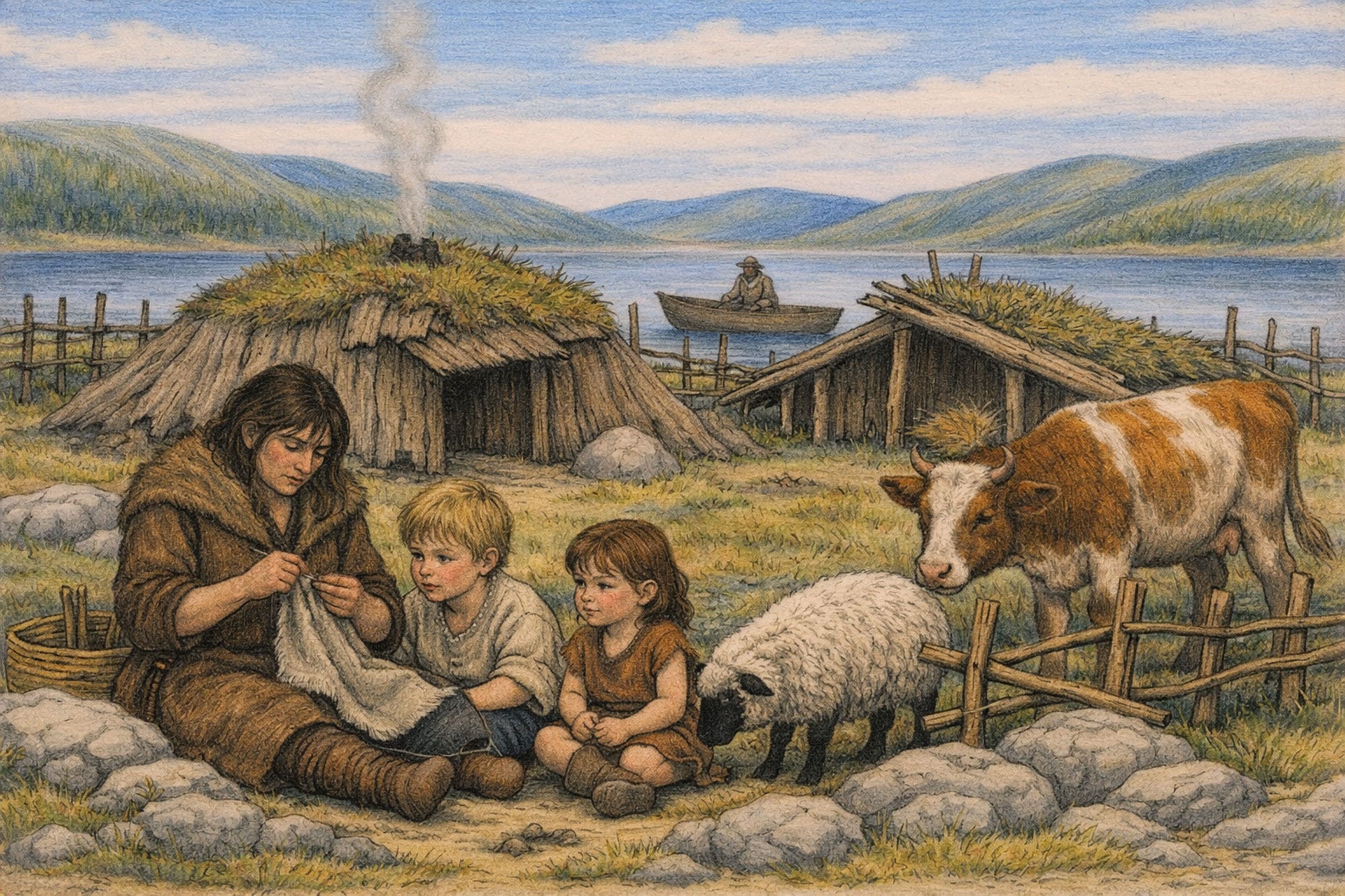
Let us journey through time again to a family group living in the same landscape as before. We are now well into the Later Stone Age — and the population is slightly larger. The climate and the mix of plants and animals are perhaps somewhat different.
We can see that there is a clear change: our family group has learned how to grow grain and keep domesticated animals. They still hunt, fish, and gather, but instead of relying only on fresh foods throughout the year, they now depend more on stores of preserved supplies. From the domesticated cows, sheep, goats, and pigs, they get meat, milk, hides, and wool.
At this point, their way of life has shifted enough to change how they use the landscape: they now need less territory to survive and have become more stationary, although not completely.
We can think of the historical Norwegian farm as a compact version of the old hunting grounds. Instead of constantly being on the move to ensure enough food to sustain the family, the newfound ways of farming gave them greater stability.
The farm and its surroundings had to provide every essential its inhabitants needed to survive. Any surplus could be used to barter for commodities they could not produce or gather themselves.
Over millennia, food preservation methods like smoking and fermenting — and, much later, salt-curing — were added to the mix. Preserved fresh food could be stored for months — even years, in many cases.
Today, we think of butter and cheese as delicacies — which they are — but above all, they are ways of preserving fresh milk. To feed the domesticated animals over the winter, the humans collected and dried grass (hay), moss, leaves, and more.
This gradual shift in ways of life laid the foundations for the more settled communities that would later define Norwegian rural life.
FARMER AND FARM
The Norwegian word for farmer is bonde — which stems from the Old Norse búandi, meaning a person with a fixed abode or someone living in one place.
The Norwegian word for farm is gård or gard — which stems from the Old Norse garðr, meaning fenced-in land, fortified site, or a garden — used to cultivate grass or crops or to safeguard domesticated animals.