
Skibladner | Norway’s oldest paddle steamer still in service
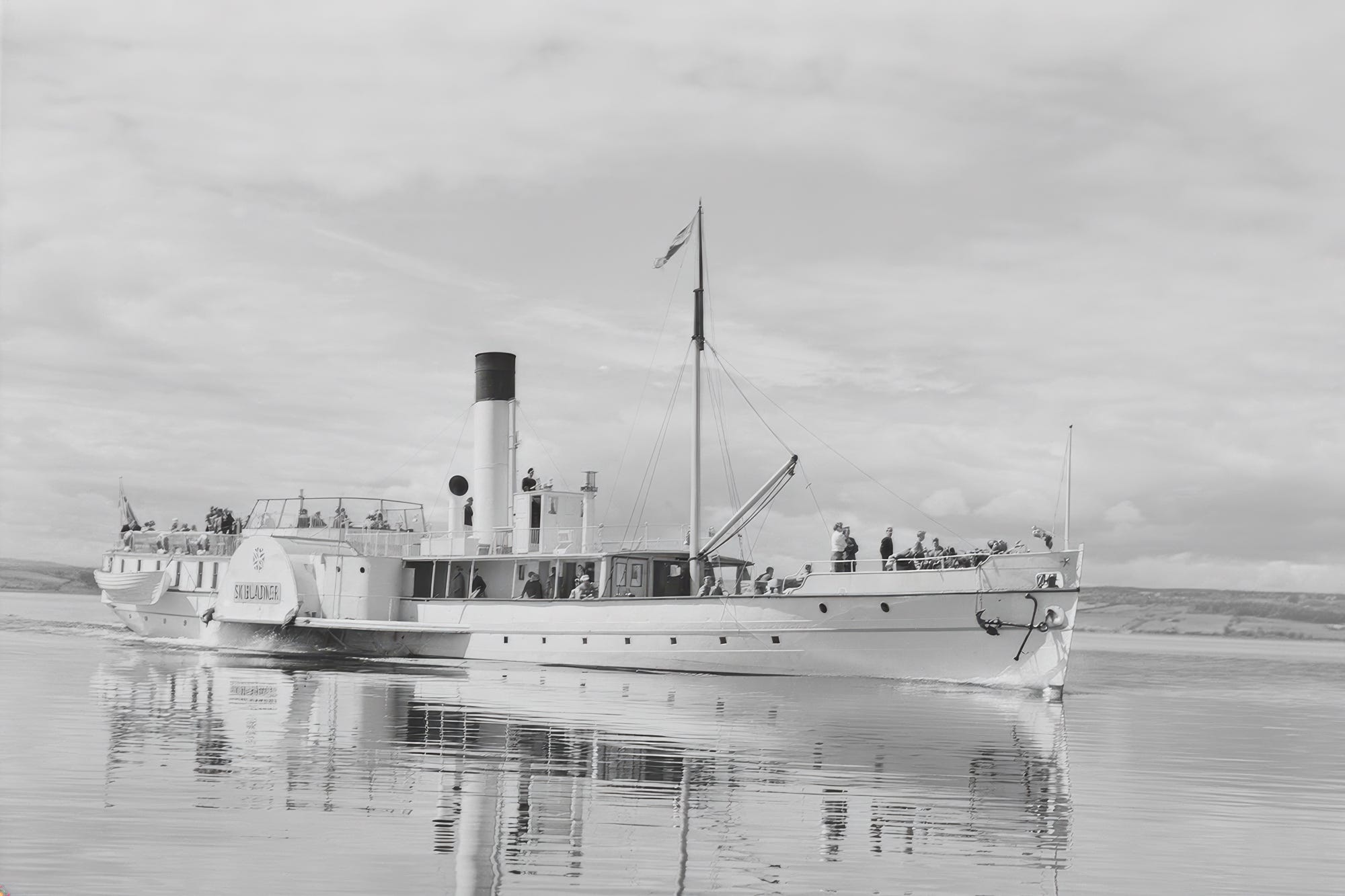
Launched in 1856, PS Skibladner still sails in regular summer service on Norway’s largest lake, Mjøsa.

Mjøsa
It was on Mjøsa that Skibladner made her maiden voyage in 1856, serving as both a passenger and a freight vessel. Remarkably, she is still there.
Mjøsa was created by the glaciers of the ice ages. It is surrounded by rolling farmland and large forests, and lies just northeast of Norway’s capital, Oslo.
The Norwegians refer to Skibladner as Mjøsas hvite svane — the white swan of Mjøsa. Her owners named her after the ship belonging to the Norse fertility god Frøy (Freyr).
Frøy’s legendary ship could sail both on land and water, always blessed with a favourable tailwind. It could also be folded up, like a piece of cloth, and put into a pouch.
Linked to Norway’s first railway
Eidsvoll, Skibladner’s southernmost stop, was and is a connection point to Norway’s first stretch of railway: the Oslo to Eidsvoll line (Hovedbanen). The railway opened in 1854.
Skibladner’s early years coincided with Norway’s budding industrial revolution. With the steam engines came a new era of prosperity and change in society.
Skibladner continued her journey through history, and had an advantage that the ever-expanding railway did not: it connected Mjøsa’s eastern and western shores.
She has sunk twice
Ice covers Mjøsa during the coldest period of winter, and it fills with mountain-snow meltwater in early summer. The ice gives Skibladner some well-earned time for rest and repair.
In 1937, she spent her winter at Minnesund. Substantial amounts of snow made her tip over to one side, and water found its way in through an open valve. She sank quickly and was barely visible above the waterline. Friendly hands joined to restore her.
In 1967, she sank once more, again at Minnesund, and this time she was uninsured. Fortunately, the Norwegian Army’s engineer corps came to her rescue.
A tourist attraction
Today, Skibladner’s winter home is a half-open boathouse at Gjøvik. From Gjøvik, Skibladner follows different sailing routes. Some days, she travels as far north as to the Olympic city of Lillehammer.
In the new millennium, Skibladner is primarily a tourist attraction and runs during the summer months only. She has room for 230 passengers and a crew of 16.
A voyage aboard Skibladner is a step into history and a journey through time. At a pleasant pace, you travel across the ever-flowing water.
Picture a sunny day on the Skibladner, lounging in a deckchair with a book or simply watching the tranquil world glide by, then later enjoying some fine dining in her rustic restaurant.
If you are ever nearby, the sound of Skibladner’s paddles may be your connection to history and to the wonders of this beautiful vessel.
Olstad, Jan H. – Knutsen, Eyolf. Skibladner 1856-1981. A/S Oplandske Dampskibsselskap 1981.