

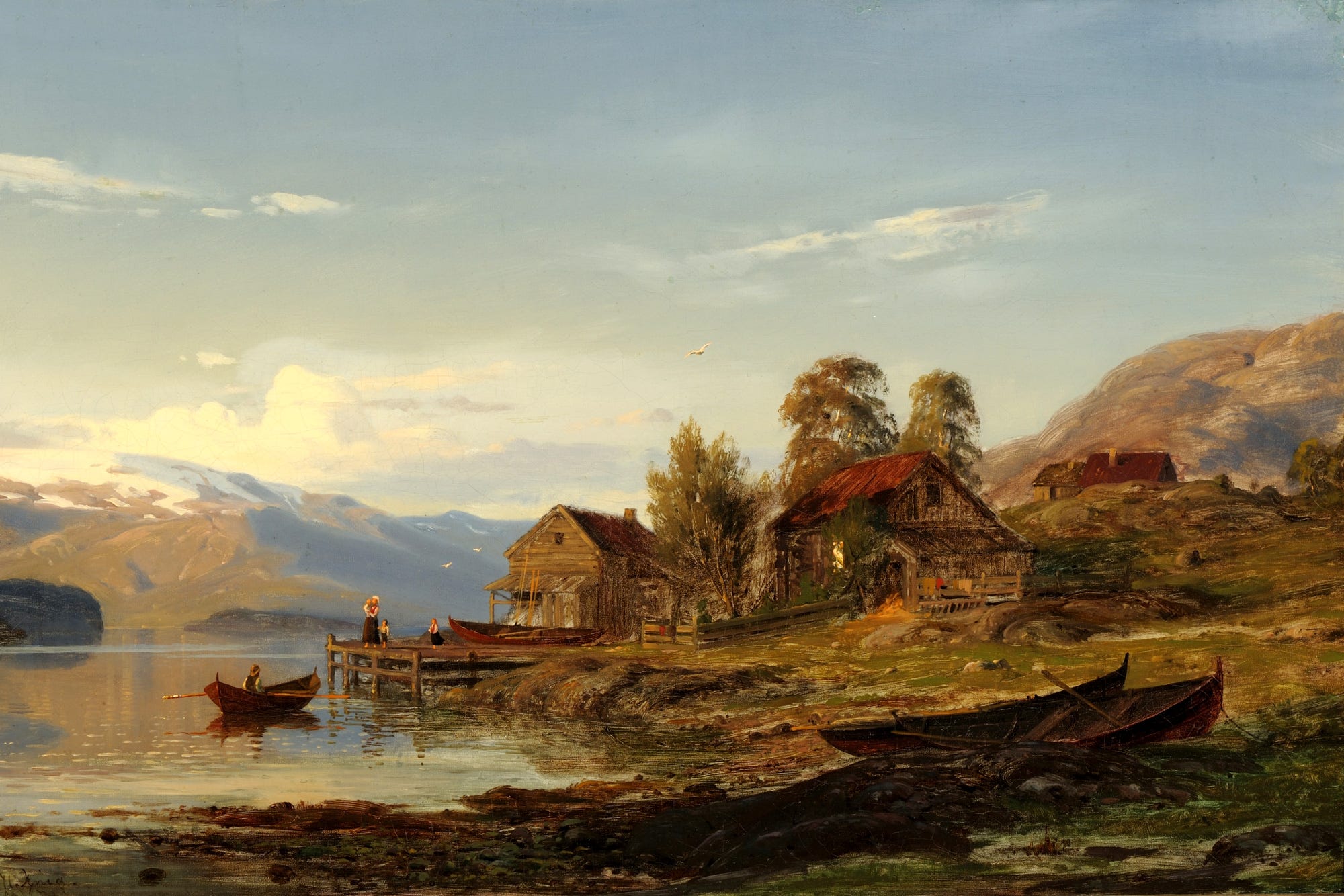
A landscape of limits
Although large areas of black, rich soil do exist in Norway, they are far from the norm. Even today, only 3.5% of mainland Norway is cultivated land, and two thirds of that is only suitable for grass production.
Norway consists of around 40% forest and 40% mountainous terrain, much of it with a shallow layer of soil intermixed with sand, clay, pebbles, stones, and rocks.
In some areas, farmers must clear their fields of stones and rocks every spring — pushed up from the ground below by the frost. Many a Norwegian farmer may have asked themselves: Will it ever end?
Farm variations
The historical Norwegian farms came in almost as many variations as there were farms. If we were to group them, we might say: coastal farms, flatland farms, valley farms, and mountain farms.
Add to this what the Norwegians call a seter: a seasonal summer location in the forests or the mountains, where the home farm sent its livestock to live and feed during the summer. The seter could be a day’s walk away, or more. The home farm meadows were needed to make hay for the winter.
One single home farm could have several seters: one for spring, one for summer, then back to the spring seter in the early autumn, before returning to the home farm for the winter.
With the farm animals on their journey came a milkmaid, who made cow’s and goat’s milk into butter and cheese — usually accompanied by an older child or two and a dog as herders. Historically, sheep’s milk was also used — and some Sami communities used milk from the reindeer.
Along the long Norwegian coast, farmers also used the many islands as grazing land.
From milder to colder
The many farm variations were also shaped by Norway’s dramatic climate differences. The North Atlantic Current makes Norway’s coastal areas far more temperate than they would otherwise be.
The further inland and higher above sea level we go, the colder the winters usually are — with the ground frozen solid and covered in snow.
The summers are short and often unpredictable. Norwegian farming — particularly in the inland and mountainous regions — has always faced significant challenges and limitations.
Imagine your ancestors
If you are lucky enough to be of Norwegian descent: to understand your ancestors, start by understanding the landscape they lived in. Much of the rest will follow from there.