
When a bear attacked milkmaid Kari Moen in 1836
In 1836, a brown bear attacked milkmaid Kari Moen from Sauherad, Telemark, Norway. Kari nearly lost her life that day.

On her way to the summer pasture farm
One early summer’s day in 1836, milkmaid (budeie) Kari Moen was on her way to the Sauherad forest land, to the lake Eiangen, and to one of the seasonal summer pasture farms (setre/setrer) in the area, Eiangsetrene.
With her on the journey were the livestock from one of the farms down in the valley and a young herder boy (gjetergutt).
For the whole summer, she and the herder boy would look after the livestock and stay in simple forest abodes.
Kari’s job was to milk the cows every morning and evening, and to make butter and cheese, getting the most out of every drop.
The boy’s job was to guard the livestock all day, as the animals grazed and enjoyed the freedom of summer.
But there was danger
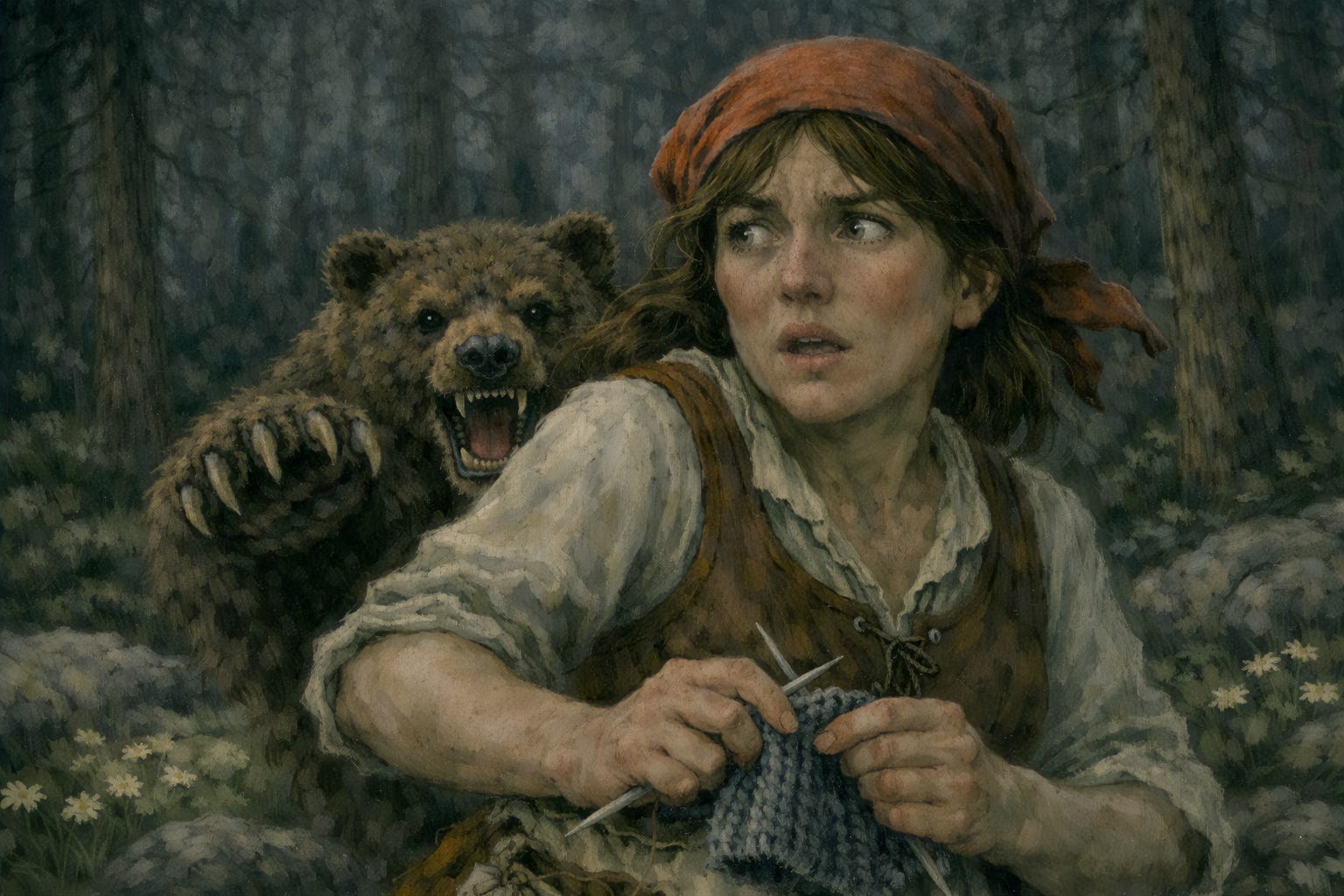
Lost in thought, Kari followed the familiar path through the forest. She walked and knitted at the same time, as most women did in those days, never an idle moment.
She hadn’t noticed that the herd and the herder boy had lagged behind and were nowhere to be seen.
Suddenly, she heard a strange snorting sound right behind her and jumped. When she turned, she saw a bear standing on its two hind legs, ready to attack.
The first blow
The bear’s first blow hit Kari on the head and threw her to the ground. Luckily, she did not faint, and knew that her only hope was to lie perfectly still and pretend to be dead.
She closed her eyes and held her breath as the bear leaned over her face, checking whether she was still breathing. Waves of pain rushed through her body.
Kari must have moved slightly, because the bear suddenly gave her three more blows and bit her across the face. Blood was streaming.
With all her willpower, Kari remained quiet and motionless.
The bear started digging a hole
The bear moved slowly towards a nearby bog-ditch and started to dig a hole to put her body in — a caching behaviour bears may use when they do not intend to eat their prey right away.
Kari half-opened her eyes and saw that the bear occasionally looked towards her, as if checking that she was not moving. She knew that this very moment was her only chance of survival.
She gathered all her strength, got up, and staggered towards where she believed the herder boy and the herd would be.
The boy screamed in terror
When the herder boy saw Kari’s bloodied face, he screamed in terror and pulled away. But she managed to call him back and calm him down.
In a hushed voice, she begged him to run as fast as he could to the nearest summer pasture farm and get help. He should tell the people there to use a boat on the lake Eiangen, so as not to risk meeting the bear when moving through the forest. Kari would meet them by the water’s edge.
The boy raced through the landscape as fast as his legs could carry him, avoiding the place where Kari had told him the bear would be.
Kari herself stumbled and crawled through the thicket down towards the lake, constantly looking over her shoulder.
Saved
The people heard the boy screaming from a long way off. As soon as he had told them what had happened, they rowed as fast as they could towards where they expected to find her.
Kari was still conscious when they found her by the water’s edge. But as soon as she knew that she was safe, she fainted.
Word was quickly sent back home, and Kari’s husband and three other men came and carried her on a makeshift stretcher down to the valley.
There, they put her in yet another boat and rowed 40 kilometres down the region’s many waterways towards the town of Skien — to the nearest doctor.
Kari Moen narrowly survived that day.
Emigrated to North America
In the mid-1800s, Kari emigrated to North America with her husband and her children.
An old saying has it that a wound made by a bear never heals. Many years later, another emigrant from Sauherad wrote to the folks back home, telling them that he had met Kari on the American prairie. At 90, she was still very much alive, but also still wearing a plaster on her nose.
Journalist Bernhard Hansen, Telemark Arbeiderblad. The story was retold in the book ‘Gjeterbarn’ by Magne Engernes. Trysil-forlaget 2000.